Wednesday, December 21, 2005

Criticizing Postmodernism
Be warned. This post uses the coarse "BS" word but it is only in quoting. Sorry.
I saw this review for a book by Harry G. Frankfurt (a Princeton philosophy professor emeritus). This is from the Amazon.com's own summary of a book titled On Bullshit:
Bulls**tting, as he notes, is not exactly lying, and bulls**t remains bulls**t whether it's true or false. The difference lies in the bulls**tter's complete disregard for whether what he's saying corresponds to facts in the physical world: he "does not reject the authority of the truth, as the liar does, and oppose himself to it. He pays no attention to it at all. By virtue of this, bullsh*t is a greater enemy of the truth than lies are."
...
...he points to one source of bulls**t's unprecedented expansion in recent years, the postmodern skepticism of objective truth in favor of sincerity, or as he defines it, staying true to subjective experience. But what makes us think that anything in our nature is more stable or inherent than what lies outside it? Thus, Frankfurt concludes, with an observation as tiny and perfect as the rest of this exquisite book, "sincerity itself is bulls**t."
A viable criticism on postmodernism: nonsense out of complete disregard for objective truth. (I added the astericks in the quote)

Tuesday, December 20, 2005

Faith in Science
I was discussing current discoveries in science with a fellow researcher from a different lab, discoveries including the cloning of a dog and the cloning of a human embryo. I mentioned that there are efforts now to create a bacteria ... well, not necessarily from scratch but assemble all of it's DNA and insert it into a cell.
He said in wonder, "Science is amazing. Soon scientists will be able to create life."
Our biology textbooks says it is a law that every cell comes from a cell. So I responded, "I don't think it's that easy to create life. There are so many complex mechanisms of the cell already in motion and are continually in motion, that to just assemble the parts will not necessarily give us life."
He glared at me, offended, silent and then rebuking, "Take off your lab coat! You call yourself a scientist. There nothing magical or mystical about life."

Where did that outburst come from?

I overheard later that he went to a conference bashing intelligent design and touting the primordial soup of evolution. Perhaps he was fired up and took it out on me.

Anyways, I was amazed at how blind he was to his blatant faith in science. He didn't offer a reason for his belief, only insult.

This again demonstrates the false dichotomy created by Emmanuel Kant: Science and Reason on one side and Religion and Faith on the other and how they are mutual exclusive (nary the 'tween shall meet). In addition Science & Reason trumps the other and so it is allowed public but Religion & Faith must be private.

[ Science + Reason ][ Religion + Faith ]

The ramifications of this wrong dichotomy are profound and far reaching. It has so ingrained itself into our minds the world over. Reality is, people live and operate by faith all the time. Most of our actions are not governed by reason. Science is no different, it involves a great amount of faith. Likewise religion* involves much rational thought. And both sides have had its share bogus superstions. (Heh, bogus superstition is redundant, no?)

[*rational thought is at least found in the Christianity laid out by the Bible]
The Loneliness of Humanity - 2
What if this is your only life in a linear timeline of this finite and unique universe? Then there are no second chances or speculation of "what if" as time pushes indomitably forward and forward until our deaths or the universe ends. [And why leave life to speculation when you are certain of your one life, your one direction in time (older), and this world?]

Two questions arise: 1. How are you living this life? AND 2. Why?

And so we are led to our yearning for significance. The Christian apologist William Lane Craig once said that apart from God there is "no meaning, purpose, and value." These cannot truly exist without God because then the only reality is randomness and chance.

And here is the limitation of science. Science ultimately is an effort to make sense of our observations. It has its place and use* but it cannot assign significance...the WHY. (*use: basically to improve quality of life... but to what end?)

Monday, December 19, 2005

The Loneliness of Humanity - 1
Many religious, science fiction authors, and scientists ponder the existence of multiple universes, multiple timelines, and multiple lifetimes mainly, they say, because of the fascination with the possibilities. "Multiple" is also substituted with "parallel," as in [parallel universes/ timelines/ lifetimes]. I'm increasingly convinced that the perseveration on these concepts is actually and untimately a rally against the finiteness of humankind and it's loneliness.

Douglas Adams, the famous sci-fi/comedy author (Hitchhiker's Guide to the Galaxy), wrote of a "torture" device consisting soley of a display of the entire universe and a "You Are Here" arrow pointing to an infinitesimal speck. The torture consisted of one's realization of his/her absolute smallness, insignificance, and loneliness in the universe and this realization driving them insane.

Sunday, December 18, 2005

Current temp.: -1°F
Current windchill: -21°F
The U.S. military is prohibiting their own chaplains from using the name of Jesus in prayer outside a church.

Saturday, December 17, 2005

Movies to see: King Kong. It has rave reviews... THE epic movie of this year. It was made to be seen on the big screen. Yes, I'm affected by the hype. But Peter Jackson had a great run at Lord of the Rings, wouldn't you say?

But first I'll see Chronicles of Narnia. Special effects courtesy of Peter Jackson's WETA Workshop.

Addendum: Narnia costumes & weapons courtesy of WETA. Special effects courtesy of George Lucas's Industrial Light & Magic.

Friday, December 02, 2005

There is no honor in a name that you do not live up to.

Monday, November 28, 2005

Major Revisions to CPR
As indicated by the American Heart Association in the journal Circulation:
A single rescuer giving CPR now give 30 compressions for every 2 breaths (instead of 15 compressions and 2 breaths) for all ages except newborn infants. The compressions are to be hard and fast at ~100/min.

Tuesday, November 22, 2005

Drive
Left the city on Friday, heading west to a conference. It was timed perfectly to watch the clouds and follow the sun set over the flat terrain. Clouds were cumulus "Simpsons" clouds that became stretched out as dusk set in. The growing molten coin of a sun struck the clouds in stripes of pink, red, and yellow. Flocks of half-thousand migrating birds coalesced and dispersed in blankets. Beautiful. Darkness came fast. Worth a thousand pictures; too bad I didn't take any. All that's left is memory.

Creation testifies to the invisible God.

Monday, November 21, 2005

Japanese Lesson 4 - Individual & Community
The Japanese culture has an underlying pressure to conform. One physician tells me: in Japan, homogeneity extends beyond ethnicity to appearances, clothing, and accessories. If you differ, people take notice and it's not culturally acceptable to stand out. That may explain why fads start and spread so quickly there, such as why so many currently bleach/dye their hair blond or brown. (But someone has to start the trends.) My coworkers seem surprised by the "individuality" expressed in the U.S. as people dress and do "whatever they want."

There is, however a current of disconnect and isolation in many families in Asia. My Japanese boss tells me that once kids are ~10 years old, they are "on their own," even in making life decisions. (Certainly they still get money, food, shelter, and the pervasive expectation to succeed.) For children, education trumps all priorities. Adults are tied to their work. Classic cases are the men of Japan who's legendary workoholic natures isolate them from their wives and children. And this is normal. Some coworkers tell me they are so use to working, they wouldn't know what to do with free time. This is not to say the families have less love, only they spend less time together and risk becoming strangers who happen living together. For examples on the disconnect of modern Asian family, I recommend the Japanese movie Shall We Dance, or a better example, the Taiwanese movie Yi Yi. Contrast that with the fascinating movie To Live.

Thursday, November 17, 2005

Japanese Lesson 3 - A View on WWII
I asked one of my colleagues about what the Japanese views of WWII were. He said many Japanese in the generation before him feel envious of the U.S. and perhaps ashamed -- not ashamed of doing anything wrong but about losing. The envy and shame seemed to be accentuated by the fact that it was the U.S. who helped reconstruct Japan after the war.

I asked, "But don't the Japanese feel any guilt for what they did?"
He responded, "The people did not know any better. The blame rests upon Emperor Hirohito and Shintoism (the national religion then). The ignorance of the people was like that of North Korea in our modern times. This is [the history] they taught at my school in Japan."

I wonder did the people know any better? Can it really be blamed on one person? It's like blaming Hitler alone for all of Germany's actions or Mussolini for all of Italy's actions. People do have consciences and people can choose right or wrong. As you may know, there were Germans during WWII who chose to do good when they hid refugees and joined the resistance movement to overthrow the Third Reicht.

Then again, in Japan, the sense of hierarchy and community over individual is so much more ingrained than in the West. And if they were like North Korea, perhaps the soldiers knew only whom they were told was the enemy.
I read another book by Shusaku Endo called The Sea and Poison. It focused on a hospital in Japan during WWII in which a team of surgeons receive a American POW, experiment on him, and kill him. Knowing what was to come down, right as the experimental operation commenced, one of the residents stepped aside because he realized the immorality of the whole business. Yet he didn't try to stop it; he just stood at a distance in nonparticipation. Another resident looked at him with disdain, thinking, 'You've already gone this far; you are as guilty as all of us.' This is an example of 1940's Japanese with consciences and knowingly choosing against it.

But this is too harsh, too much of a strawman. There is a famous Yale study on people responding to authority. You may know the Milgram experiment consisting of a researcher (E), a test subject (S) and a voice actor (A). The researcher told test subjects to be teachers prompting an oral exam. The actor played a student responding to the exam questions. If the student answered wrongly, the teachers were told to to press switches that inflicted an electric shock to the student. Each incorrect answer led to a stepwise increase in electric shock up to a lethal dose. The student would initially act angered, then start screaming, and finally stop responding altogether, as though unconscious or dead.
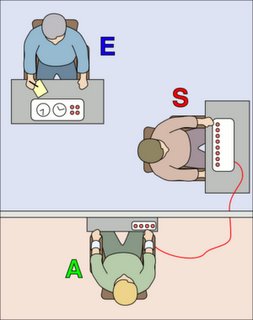
This study found that 65% of normal adults sampled punished the students to the maximum lethal 450 volts when commanded by an authority (the researcher). 0% stopped before 300 volts. This shows how weak people's minds are -- malleable to people in authority, not just to "group think." But the test subjects still made a choice against their conscience as revealed by their hesitancy and agitation through the process, looking back at the researcher before untimately choosing against good. It also shows how easily people choose evil.

The question then is, what leads people to make the moral choice? What distinguishes those few who resisted Nazi Germany and the few who quit early in the Yale study?

Tuesday, November 15, 2005

I had tapas with a handful of friends on Saturday. Among them was my good friend from South Korea. He is always an encouragement to me, spurring me towards the Lord. It still makes me wonder that my friend is a father. He took his folded cloth napkin and energetically rocked it on his arms and sang to it, showing how he sings to his son. He's still the dynamic combination of goofiness, charisma, wit, and perceptiveness.

Monday, November 14, 2005

Opium for the Guilty
I recently asked a friend, "Do you believe God exists?"
"Sometimes I do. Usually I don't."
"Let me guess. You believe God when something bad happens or worries you; not when things are good."
"Yes, yes."
"Humans are so often like that. Seeking God only when there is no other option."

This friend from Japan goes on to describe his culture as composed of agonistics, atheists, and animists. And from what I know, Japan is a desperately dark place. Even from such an environment, my friend has an awareness of God. And whether we choose to accept or deny God's existence, that does not change the reality of His existence.
For since the creation of the world God's invisible qualities--his eternal power and divine nature--have been clearly seen, being understood from what has been made, so that men are without excuse.
Romans 1:20

It is said that religion is the opium for the masses. However isn't atheism the opium for the guilty? What guilt? The guilt before a just and holy God. Mentioning a just and holy God right away makes most people want to stop listening. The rebellious heart bristles.
For although they knew God, they neither glorified him as God nor gave thanks to him, but their thinking became futile and their foolish hearts were darkened. Although they claimed to be wise, they became fools
Romans 1:21-22

The fool says in his heart,
"There is no God."
They are corrupt, their deeds are vile;
there is no one who does good.
Psalm 14:1

Humankind is guilty of sins and in the pleasure of evil, most deny God by the way they live. Too many times our thoughts are/were so twisted that we think: God -- the source of all good -- is the worst thing that can happen to us, when in fact nothing could be better. Let us not become callous, but instead turn from our own ways, seek after Him and never stop to run the good race.
"For God so loved the world that he gave his one and only Son, that whoever believes in him shall not perish but have eternal life. For God did not send his Son into the world to condemn the world, but to save the world through him. Whoever believes in him is not condemned, but whoever does not believe stands condemned already because he has not believed in the name of God's one and only Son. This is the verdict: Light has come into the world, but men loved darkness instead of light because their deeds were evil. Everyone who does evil hates the light, and will not come into the light for fear that his deeds will be exposed. But whoever lives by the truth comes into the light, so that it may be seen plainly that what he has done has been done through God."
John 3:16-20

Saturday, November 12, 2005

China's Communist Party and an "Insider"
The Washington Post recently published a story on a Party whistle-blower, Huang Jingao, who posted a letter on the Internet accusing fellow politicians of "crooked land deals," accusations which triggered an outcry from China's citizens against all the corruption. To stifle this, the propaganda department erased all Web posts and the journalist who publicized the letter was arrested. Huang started receiving death threats, his credibility was defamed (sleeping around with women and taking bribes), and he was sentenced to life in prison for allegedly accepting bribes.

Doesn't this make you wonder what is truly going on? Why the cover up? Why the two-faced media? The citizens are responding to something real. Corruption is happening.

How to root out corruption?
  • Journalistic integrity and independence from political forces;
  • Coupled this with government transparency to show what officials are doing and how money is (mis-)used.
Once, I chuckled at the concept of journalists as "defender of democracy" but there is some truth to that; for how do you control people? By controlling their ideas. How do you control ideas? By controlling the content and flow of information.

What about the officials?
  • Checks and balances: do they exist?
  • Elections: How do officials get into office? With only one political party there are no real election and no real representation, right?

Such changes sound like democracy... a dangerous idea to the Communist ears.

Arrg, I never thought of myself as so political. But governments are in place to enforce morality and justice, which I care about.

Friday, November 11, 2005

Japanese Lesson 2 - Kanji
When my Japanese colleagues are unable to tell me something in English they would sometimes write it out in Kanji (Chinese characters). However I can't read Chinese. Being that such characters are a part of the written language of the Japanese, Koreans, and Chinese, it would be benificial to know how to read and write Kanji if one wishes to communicate. I see the great benefit in Kanji's ability to span the spoken languages of these three people groups and the many spoken languages among the Chinese people alone.

There is an interesting difference in the Chinese and Japanese pronounciation of Kanji characters. In Chinese, each character represents one word and one syllable. In Japanese, the same character has nearly the same meaning but it may be pronounced with up to four syllables. (I'm not sure how it is in Korean.)

Sunday, November 06, 2005

The Enemy on Our Airwaves
Interesting editorial concerning media and terrorism.
http://www.opinionjournal.com/extra/?id=110007498
There is no such thing as a private moment.

Nothing is hidden from God.

Sunday, October 30, 2005

China Morality & Economy
In the October 3 Chicago Tribune I read two interesting articles on China.

1. One addressed repercussions of the One-child Policy: Through the services of the so called family planning (euphemism for population control), many Chinese women are forced sterilized & their pregnancies forced aborted by local authorities. These officals are pressured to meet a population quota for their region of governance. There are incidents of couples who have their only child die and because of forced sterilization they could never have a child again. This is the story of millions of lives taken and ruined by this system. Yet it's seen as a necessary and good thing because of the challenges in suppling food, water, clothing, shelter, electricity to a nation of 1.3 billion people. When such women evade authorities, their families are imprisoned and the family businesses shut down to coerce the women to turn themselves in.

Add to this the gender imbalance of men far outnumbering women because of the voluntarily aborted female fetuses after gender idenfication on ultrasound. This speaks of a culture that still values women less than men.

As parents outnumber children 2:1, the generation imbalance become more pronounced. Each member of the future generation has an increasing large elder population to support.

Then there is the Little Emperor/Little Empress phenomenon of only-children spoiled by the parents and grandparents in a period of economic boom as reported by Fortune magazine. They develop a sense of entitlement because they have yet to taste hardship. Entitlement may only be balanced by the family's expectation/pressure to succeed.

2. The other article addressed China's businesses reaching the world: If you didn't already know, Chinese corporations are taking steps to take on the world. They hope to join the ranks of Toyota, Sony, GE, GM, Yahoo in terms of reach and brand reputation. The prime example is the company Lenovo (part of the company Legend Holdings) which purchase IBM's PC division to make it the largest PC seller in China and the third largest PC maker in the world. It has become a marketing member for the 2006 Winter Olympics to get its name out. Lenovo has established a research center in North Carolina's Research Triangle to access new innovations. This reflects the type of rapid expansions occurring with corporate China.

Whereas China loves to tout its economy, it trys to suppress people from reporting human rights violations. Neither do it's own people nor does the world knows the extend of the people's grievances. This new found prosperity has welcomed rapid comercialization and a glut of materialism -- China has already become the 3rd largest car market in the world and is predicted to overcome Japan as 2nd (U.S. is 1st).

Thursday, October 27, 2005

Let's go White Sox

Photo by Shaun Best/Reuters
Tonight I watched the Chicago White Sox sweep the Astros to a World Series Championship in a 1-0 game. You may already know it's been a long time coming (88 yrs. since 1917). Woohoo! It's pretty incredible, the Sox somehow pulled it off each game. Not somehow, but by the 25 players who hustle, players playing for the team, level heads, awesome pitchers, clutch hitters, solid fielding, timely coaching. Honestly, I've not been a Sox fan but the humility and work ethic is refreshing. Good for Chitown.

You can hear the fans whooping and cheering in the streets, inciting cars and even semi's to respond with honks; and honks inciting cheers down the streets.

(Now the Cubs need to win next. Come on it's been since 1908!)